Labyrinth Walking as Meditation
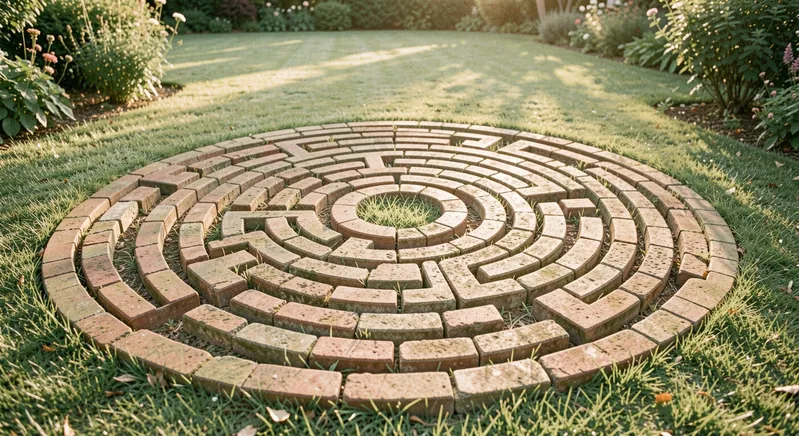
A labyrinth is a single path that winds to a center and winds back out. It has no branches, no dead ends and nothing to solve, which is exactly why it works as meditation: the walker can stop navigating and simply walk. The pattern is found on floors of medieval cathedrals, in hospital gardens, on retreat grounds and painted on church parking lots. This guide explains how to walk one as a moving meditation, the three stages the tradition gives to the walk, what the pattern has meant in Christian use, and how to find a labyrinth to try.
Labyrinth or maze
The confusion is the first thing to clear. A maze multiplies paths: walls force choices, wrong turns exist, the point is puzzle and difficulty. A labyrinth is unicursal: one path in, the same path out, and the only possible mistake is leaving early. The walker's mind, primed for mazes, keeps trying to second-guess the turns for the first few minutes, then gives up, and that surrender of the inner navigator is where the meditation begins. Medieval builders knew what they were doing when they laid labyrinths into cathedral floors.
The three stages of the walk
The tradition teaches the walk in three stages. The first, going in, is release: the walker sheds the surface noise on the way toward the center, and the winding path, which never runs straight for more than a few steps, does the shedding. The second stage, at the center, is receiving: the walker stands or sits in the middle for as long as feels right, in prayer, in stillness, with whatever arrived on the way in. The third stage, going out, is returning: the same path walked back toward the world, and the walker commonly takes something of the center back out, a settled phrase, a resolution, or simply a slower pulse. The whole cycle takes twenty minutes to an hour depending on the labyrinth and the walker.
How to actually walk one
No instruction is needed beyond courtesy. Walk at whatever pace the body offers, which is usually slower than the first instinct. Pass slower walkers by stepping aside and rejoining the path. If others are walking, silence is the custom. Shoes stay on, children are welcome and often better at it than adults. A walker can carry a question in, and let the turns hold it, or carry nothing at all; the tradition allows both. There is no wrong way to walk a labyrinth, a sentence that is easier to believe after the third visit than the first.
What the pattern means in the Christian tradition
The best-known Christian labyrinth is the great twelve-ring pattern inlaid in the nave of Chartres Cathedral in the early thirteenth century. Medieval pilgrims who could not travel to Jerusalem walked it as a symbolic pilgrimage, which is why the center rosette is read as the holy city. The pattern itself is older than the churches that hold it: four- and seven-circuit labyrinths appear on Mediterranean floors and coins many centuries before. In its Christian use the winding way became an image of the spiritual life, which makes real progress while seeming to circle, arrives where it always intended, and cannot get lost on the way. That is a theology in a floor.
Why the practice returned
Labyrinths all but vanished from church life for centuries, and the modern revival is unusually datable: it spread from the 1990s through the work of Grace Cathedral in San Francisco and the Veriditas network of Lauren Artress, which put canvas labyrinths in parish halls and taught the three-stage walk. Hospitals followed, on the evidence that slow walking lowers stress, and retreat centers followed the hospitals. Today labyrinths sit in a striking range of places: churchyards, convent gardens, school grounds, memorial parks and public parks, most of them maintained quietly by a local group.
Labyrinths on retreat
A labyrinth on the grounds is one of the features a retreatant can hope for, because it fits the day's architecture perfectly: a walk between the morning prayer period and lunch, or at dusk after the last conference. The Cenacle Retreat House in Houston had one among its nine bayou-side acres, and its labyrinth long appeared on local lists of Houston-area examples, as the guide to Houston-area labyrinths recounts. The walk belongs naturally beside the other practices of the spiritual practices section: it is the moving counterpart of contemplative prayer, and many directors prescribe one as a first practice for people who cannot yet sit still.
Walking without a labyrinth
Where no labyrinth stands nearby, the practice adapts. Any fixed walk of twenty minutes, a garden circuit, a hallway, a rosary walked slowly, carries the same structure of release, receiving and return, provided the route is fixed in advance and repeated. Some retreatants draw a finger labyrinth on paper, tracing the folds before bed. The form matters less than the surrender of navigation that it produces.
Where to find one
The World Wide Labyrinth Locator maintained by Veriditas lists thousands of public labyrinths by place, and a search there is faster than any directory a local paper could print. Church websites announce them more often than they hide them, and retreat centers usually mention a labyrinth on their grounds page. When visiting, the etiquette is the quiet kind: check the opening hours, avoid organized events unless joining them, and leave the path as it was found.
Further reading: Veriditas, the labyrinth network founded at Grace Cathedral, maintains the World Wide Labyrinth Locator and the standard introduction to the three-stage walk.