Labyrinths in the Houston Area
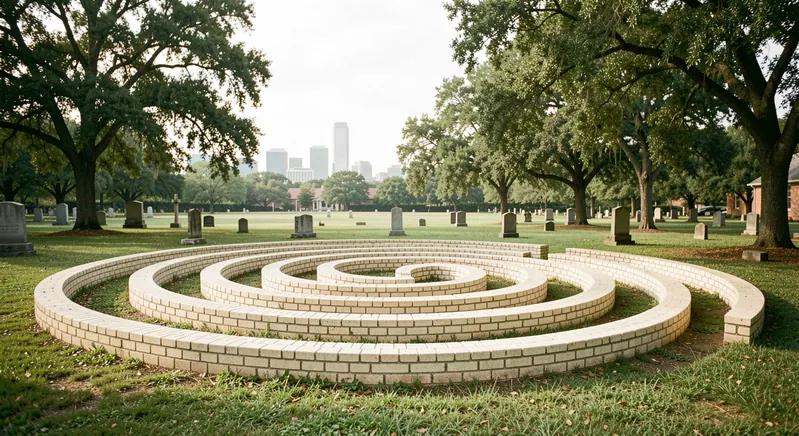
Houston has a documented place in the American labyrinth revival. The city's labyrinth tradition connects a retreat house by Buffalo Bayou, a public radio guide to walking meditation, and the churchyards, hospitals and campuses where the paths stand today. This guide explains where labyrinths are found around Houston, how the local tradition grew through the Cenacle Retreat House, and how to plan a first visit to one.
Where labyrinths stand in a city
Labyrinths cluster where quiet is already being kept. Churchyards and memorial gardens hold many of them, laid in brick or stone beside the sanctuary. Hospital and hospice gardens hold another share, on the simple logic that a walkable meditation serves the waiting. Retreat and spirituality centers keep them on their grounds, schools paint them on playgrounds, and a few stand in public parks. A visitor looking for one in Houston will find the search running through exactly these addresses: a parish, a medical campus, a retreat ground, a park. The practice itself, the three-stage walk, is described in the guide to labyrinth walking as meditation.
The Cenacle labyrinth
The best documented labyrinth in the city's retreat history stood on the grounds of the Cenacle Retreat House at 420 N. Kirkwood Road, the retreat house the Cenacle Sisters ran on nine acres bordered on three sides by Buffalo Bayou. Among its walking paths, the labyrinth served retreatants on the pattern described elsewhere on this site: a walk between conferences, at dusk, or as the moving half of a day of prayer. The house's labyrinth appeared on local lists of Houston-area examples, the kind of listing a public radio station compiled for walkers seeking a path, which is the paper trail by which a garden feature becomes local history. The house closed in 2020; its story is told in the history section, and its labyrinth belongs to that story now.
A quiet local tradition
What made the Houston labyrinth scene unusual was less any single path than the company it kept. The Cenacle's labyrinth belonged to a retreat tradition that also taught contemplative prayer and spiritual direction, so the walk arrived in the city already embedded in practice rather than as decoration. When the national revival of the 1990s spread canvas labyrinths through parish halls, Houston had both the older retreat-house example and the new wave, and the two reinforced each other. Retreatants who learned the walk at the Cenacle, or at a parish evening, carried it to their own congregations, which is how most labyrinths in any American city arrive: carried, not commissioned.
How to find a labyrinth today
The reliable method is the World Wide Labyrinth Locator maintained by Veriditas, which lists public labyrinths by city and state, including open hours where they apply. Beyond the locator, three local searches serve well: parish and church websites, which usually mention a labyrinth on the grounds page if one stands there; hospital and hospice websites, whose garden pages name their meditation paths; and retreat centers, which are the most likely to welcome a visitor who simply wants to walk. In the Houston area the continuing center of the retreat tradition is Emmaus Spirituality Center, and the wider Texas field is described in the guide to retreat centers in Houston and Texas.
Planning a visit
A first visit asks for less than most people pack. Choose a time outside organized events, since many labyrinths host occasional guided walks, especially in Lent. Wear ordinary walking shoes. Expect the walk itself to take twenty minutes to an hour. If others are present, keep the custom of silence and pass gently. A visitor carrying a question will find the winding path holds it well; a visitor carrying nothing will find that works too. The etiquette of passing, pausing at the center and walking out is laid out in the meditation guide's section on how to walk.
The Gulf Coast setting
Walking a labyrinth in Houston has a local texture: live oaks and Spanish moss on the shaded sites, a flat horizon, heat that makes morning and evening the generous hours for most of the year. The retreat tradition that brought labyrinths to the city always scheduled its walking accordingly, and a visitor does well to inherit the habit. The scene descriptions across this site, from bayou banks to churchyards, come from that same country.
When a standing labyrinth is far
For readers far from any path, two consolations are practical. The locator covers all of Texas, and a path often stands nearer than expected, at a county-seat church or a hospital garden. And the walk itself, as the meditation guide explains, can be approximated: any fixed repeated route walked without navigation carries the same release, receiving and return. What the tradition wants preserved is not the geometry but the surrender of the inner navigator that the geometry produces.
A closing note on care
Public labyrinths survive by being treated as the quiet things they are. Visitors who find a path overgrown or damaged can usually reach a grounds committee or parish office with a short note, and the note is welcomed; most of these paths are maintained by a handful of volunteers. That is the last similarity between Houston's labyrinths and the retreat houses that carried them here: both run on the quiet labor of people who believe a path to the center is worth keeping open.
Further reading: Veriditas maintains the World Wide Labyrinth Locator, the standard index of public labyrinths by city.